

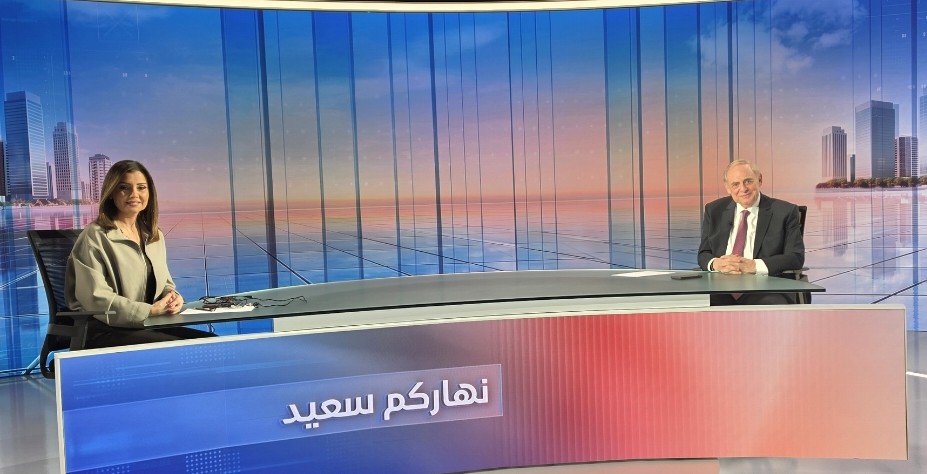
The Chairman of the Parliamentary Committee on National Economy, Industry, Trade and Planning, MP Dr. Farid Boustany, stressed in a television interview the necessity for Lebanon to be present and active in all talks and negotiations concerning its affairs, affirming that no party is allowed to negotiate on its behalf. Lebanon must defend its interests and impose its presence at all dialogue tables, including the talks held in Islamabad.
Boustany considered that the visit of the US envoy may carry positive indicators regarding avoiding a vacuum in the South after the withdrawal of UNIFIL forces, noting that the presence of these forces in Lebanon since 1978 had a positive impact, despite their failure to fully stop violence and escalation.
On the regional level, Boustany said that Gulf countries are going through a serious and acute crisis, but they have the strength, resilience and awareness needed to overcome it and restore their prosperity. He expressed optimism about Lebanon’s economic future in the medium term, provided political stability is achieved, pointing to serious intentions to invest in Lebanon, but translating these intentions requires providing the appropriate environment, opening doors to foreign investments, in parallel with working to preserve existing investments.
In this context, he called on the Government to open a dialogue with the Al Habtoor Group, and to study ways to preserve its investments in Lebanon, considering that protecting existing foreign investments is no less important than attracting new ones.
Boustany praised the plan being prepared by the President of the Civil Service Board, Nasreen Mashmoushi, to restructure the public sector, describing it as very good, and noting that it will be presented at the end of the week, and constitutes an important step toward activating the performance of the public administration and improving its productivity. He also called for moving, starting with the 2028 budget, to preparing and approving budgets extending over three years, instead of limiting to annual budgets, in order to give the State an economic and financial future vision, in line with international standards in planning and public finance management.
Regarding the banking sector, he considered that the banks’ decision to strike tomorrow is unfortunate, pointing out that the profits achieved by banks during the crisis years are real profits and not merely book profits as they claim. He stressed, in return, the importance of having a sound and healthy banking sector, alongside an organized, strong and solid insurance sector, as two fundamental pillars of the Lebanese economy. Boustany denied what was raised in the media about him conducting negotiations with Eurobond holders, clarifying that he met with them in his parliamentary capacity, and that he has the right to be informed about the truth of what is happening in this file, given its great impact on citizens’ lives and the Lebanese economy.
On the file of Syrian displaced persons, Boustany affirmed that the time has come for their return to their country according to a clear timetable, considering that Lebanese society and economy are no longer able to bear the burdens resulting from the continuation of this reality, and that the government measures taken in this regard remain insufficient, and need more seriousness and effectiveness.
On the educational issue, he stressed that preserving the level of education in Lebanon must be a national priority, away from sectarian and regional considerations, criticizing the performance of the Minister of Education, and calling on her to change her working approach and put in place a clear strategy that protects the level and quality of education, affirming that science and culture constitute Lebanon’s first wealth.
He also warned of the risks resulting from the sale of land in Mount Lebanon, considering that this phenomenon threatens the identity of the regions and could lead to dire consequences, which requires dealing with it with national responsibility.
Boustany addressed the reality of infrastructure, considering that it needs a comprehensive development workshop, questioning the feasibility of expanding the port’s capacity while the road network remains as is, without expansion or real improvement for more than fifty years, which limits benefiting from any expansion in vital facilities. Regarding road paving works in the Chouf, he pointed out that the distribution of works was not fair, as secondary roads and alleys were paved, while main roads were excluded, and other roads were left after being dug without completing the works, calling for adopting clear and fair criteria in implementing development projects.
In a related context of protecting citizens’ purchasing power, Boustany revealed that he prepared, during the month of October, on a personal initiative, a Price Index that included a basket of basic food and consumer goods comprising 20 items, whose prices were monitored in five of the largest chain supermarkets, which account for about 80% of the market for selling these goods in Lebanon.
He explained that the results of the study showed price stability during October, after the large increases had occurred in previous months, affirming that work will not stop at this point, but the index will continue to include November and December, with close monitoring of price movements, especially during the holiday period, to prevent any exploitation of citizens or imposing unjustified increases aimed at achieving additional profits.
Boustany concluded by affirming that he will not hesitate to name any supermarket or merchant proven to have exploited citizens and raised prices abnormally or unjustifiably, and to expose violations to public opinion, up to holding a press conference to present the results and data, based on his responsibility to protect consumers and confront any attempt at exploitation.