

George Saad
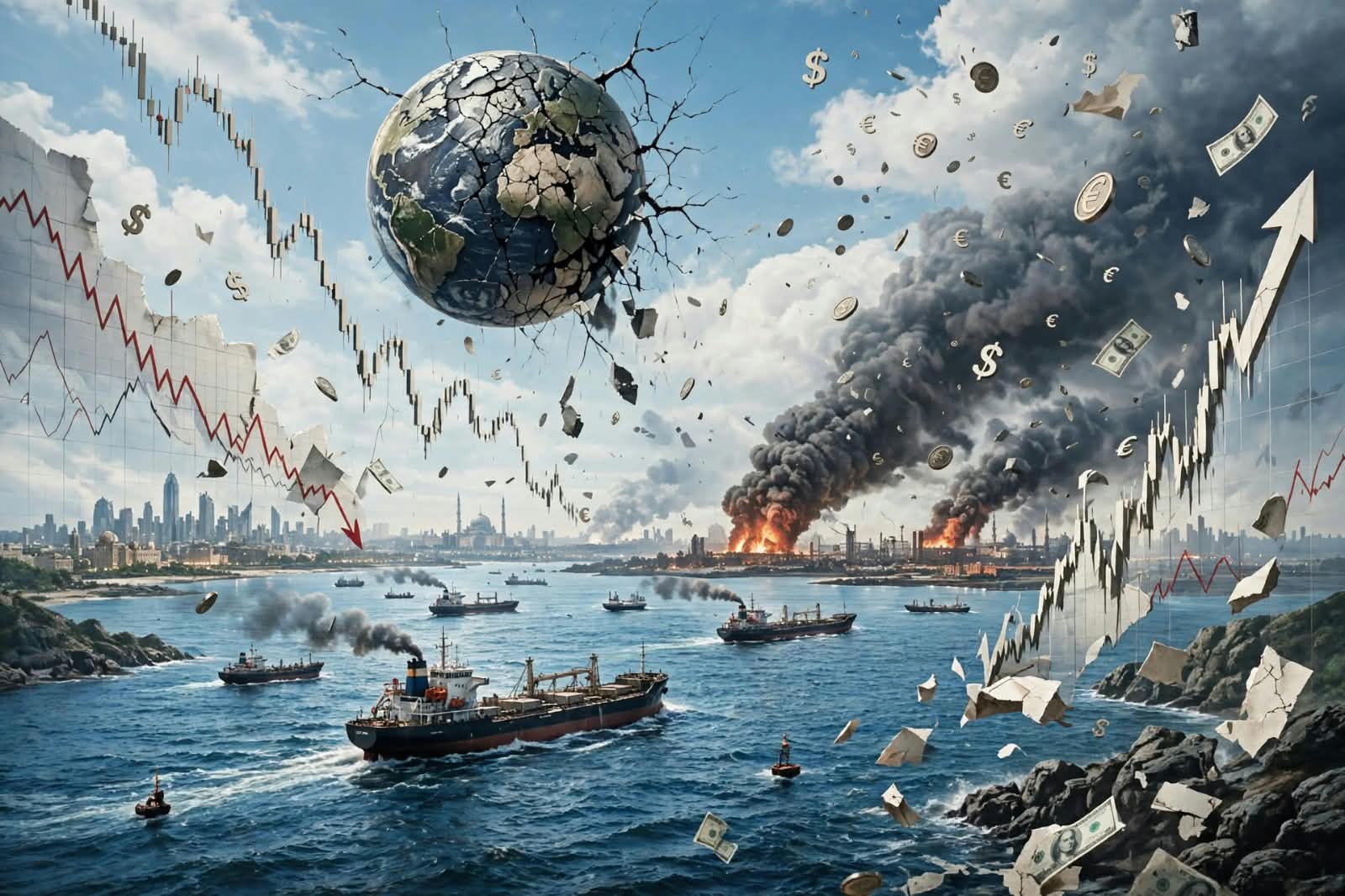
The American war on Iran was not a war confined to Iranian geography, nor to the military battlefields of the Middle East. From its very first moment, it was an economic and financial earthquake that struck the entire world, from the oil markets in the Gulf, to the European stock exchanges, to the pockets of ordinary citizens in the Americas.
Iran is not a marginal country in the global energy equation. It sits on the shores of the Strait of Hormuz, the artery through which about 20% of the world’s oil and one-third of liquefied natural gas pass daily. Any threat to this strait, or any disruption to navigation through it, means an immediate insane rise in energy prices, paralysis in supply chains, and a collapse in investor confidence.
First: The Arab Gulf… At the Heart of the Storm
The Arab Gulf states were the first to pay the price, and the highest price.
With the start of the war, insurance prices for oil tankers and commercial ships in the Gulf rose to unprecedented levels, and some global shipping companies stopped crossing the strait, or imposed exorbitant war-risk fees.
The Gulf stock exchanges in Riyadh, Abu Dhabi, Dubai, Doha and Kuwait fell sharply in the first days, losing billions of dollars in market value. Sovereign wealth funds were forced to withdraw investments from global markets to cover the emergency deficit and secure liquidity.
As for the tourism and aviation sector, on which Gulf states bet as an alternative to oil in Vision 2030 and beyond, it received a severe blow: thousands of flights cancelled, airspace closed, hotel bookings declined, and foreign capital fled in search of safety.
At the same time, Gulf states found themselves forced to increase their military and security spending urgently, at the expense of development, infrastructure, education and health projects.
Second: The Arab Countries… A Double Bill
Outside the Gulf, the impact was deeper and more dangerous on non-oil Arab countries, such as Lebanon, Egypt, Jordan, Syria, Iraq and Yemen.
The rise in oil and gas prices was immediately reflected in the prices of electricity, transport, bread and food. Inflation jumped to record levels, local currencies fell against the dollar, and foreign debts became heavier.
In Lebanon, which is already living through a suffocating economic crisis, the war led to an almost complete paralysis of commercial activity, a rise in fuel prices, a new displacement, and a halt to aid and investments that had been expected.
In Egypt and Jordan, which depend on tourism, expatriate remittances and the Suez Canal, revenues were directly affected, ship traffic in the Suez Canal declined, and gas supplies were affected.
As for Iraq, Syria and Yemen, they turned into additional arenas of economic attrition, where reconstruction projects stopped, the cost of food and medicine rose, and the numbers of displaced people and the poor increased.
Third: Europe… A New Energy Crisis
Europe, which had not yet fully recovered from the energy crisis that followed the Russian-Ukrainian war, found itself facing a new, harsher crisis.
Natural gas prices in European markets jumped by more than 60% within weeks, and electricity prices rose in Germany, France, Italy and Britain, forcing hundreds of factories to reduce production or temporarily close their doors.
Inflation returned to strike the continent, and the European Central Bank found itself helpless between raising interest rates to curb inflation, and lowering them to support the declining economy. As for the ordinary European citizen, he paid the price in his heating bill, the price of bread, the cost of transport, and the decline in purchasing power.
The refugee crisis also returned to pressure Europe, with new waves of displacement from the Middle East, and rising costs of reception and humanitarian aid.
Fourth: The Americas… The War Returns Home
In the United States itself, which launched the war, the economy was not immune to the repercussions.
Gasoline prices at American stations rose sharply, exceeding record levels in some states, sparking a wave of popular anger, and affecting the popularity of the American administration.
American stock exchanges, Wall Street, witnessed violent fluctuations, and technology, aviation and automobile companies lost billions of dollars. The cost of the war itself on the American treasury also rose, with increased military spending, and a rise in public debt that already exceeded 36 trillion dollars.
And in Latin America, from Brazil to Argentina and Mexico, food and energy prices rose, and their exports declined due to disruption in global shipping, and rising costs of insurance and maritime transport, which exacerbated poverty and debt crises in those countries.
Conclusion: No One Wins
The American war on Iran proved one truth: in an economically interconnected world, there is no local war.
The Gulf lost its financial stability, the Arab countries lost their food security, Europe lost its energy security, and America itself lost its economic and financial stability.
And the question that arises today: How long will the world continue to pay the bill for wars that do not make peace, but only make more poverty, inflation and collapse?
Nothing bodes well, as long as the logic of war advances over the logic of diplomacy and economy.