
- Relations with Iraq are deeply rooted in history
- I expressed full willingness to put Lebanese ports at the disposal of Iraqis and to receive Iraqi tankers as well
- The Lebanese people have the right to demand more than what has been achieved
- The bulk of Lebanon’s internal problems stem from corruption, mismanagement, and lack of accountability
- Restoring confidence requires carrying out the reforms we are undertaking, because Lebanon needs them
- This is an internal need before it is an Arab or international need
- About 84% of Lebanese depositors have less than $100,000, and some of their accounts have been closed successively
- In accordance with circulars issued by Banque du Liban, and others must obtain their rights
- Israeli withdrawal is our primary goal, in addition to reconstruction, the return of the displaced, and the release of prisoners
- I recall that Article 10 of the Framework Agreement stipulates support for the Lebanese state in the reconstruction process
- We say to Hezbollah: You are Lebanese and part of the state
- Hand over your weapons so that we can have a strong central state that takes care of protecting its citizens at home and abroad
- We expect second, third, and fourth rounds of negotiations, pending the formation of the Israeli government
- Negotiations are not a concession, and the negotiator must know how to do his job and assess when to be firm and when to be flexible
- It is unacceptable for anyone to undermine Lebanese sovereignty and the role of the Lebanese Army
- Whoever wishes to verify disarmament can resort to an international team
President of the Republic General Joseph Aoun affirmed that relations with Iraq are deeply rooted in history, and during the 1950s, there was talk about activating an oil pipeline flowing to the north, originating from Iraq, which still exists.
He said: I expressed full willingness to put Lebanese ports at the disposal of Iraqis and to receive Iraqi tankers as well, or to use Lebanese tanks and the possibility of exporting crude oil from Lebanon, which is realistic and not difficult, and will be among the points of discussion with the Iraqi Prime Minister during his expected visit to Lebanon tomorrow.
The President pointed out that “one of the most important things we are working on is rebuilding trust between the Lebanese people and their state on the one hand, and between the state and the Arab and international community. We must make a greater effort, and in return we hope that our Arab brothers will stand by us more.”
President Aoun stressed that what is required first as a basic step is the Israeli withdrawal from southern Lebanon. Studies are available for the reconstruction of the damaged areas. He said: We are trying, through direct and indirect contacts with Hezbollah, to confirm that weapons are no longer useful, and that the state is the one that protects everyone, and we are talking to it and calling on it to talk together in order to reach a peaceful solution for its weapons.
The President said: We expect second, third, and fourth rounds, but that is pending the formation of the Israeli government, but in absolute terms, I stress that we have no option but to adopt diplomacy, for negotiations are not a concession, and the negotiator must know how to do his job and assess when to be firm and when to be flexible.
President Aoun opposed Israel verifying disarmament, and stressed the unacceptability of anyone undermining Lebanese sovereignty and the role of the Lebanese Army, and “whoever wishes to verify can resort to an international team (Arab or European), but it cannot be Israeli because it is unacceptable for it to be both adversary and judge at the same time.”
He explained, on the other hand, the pursuit of the best relations with Iran, but built on mutual respect and non-interference in internal affairs. “What the Iranian does not accept for himself, I cannot accept for Lebanon.”
He pointed out that Lebanon does not accept being used to threaten Syria, and vice versa, and seeks the best relations, and things are moving in the right direction for the good and interest of both countries.
Inauguration Speech
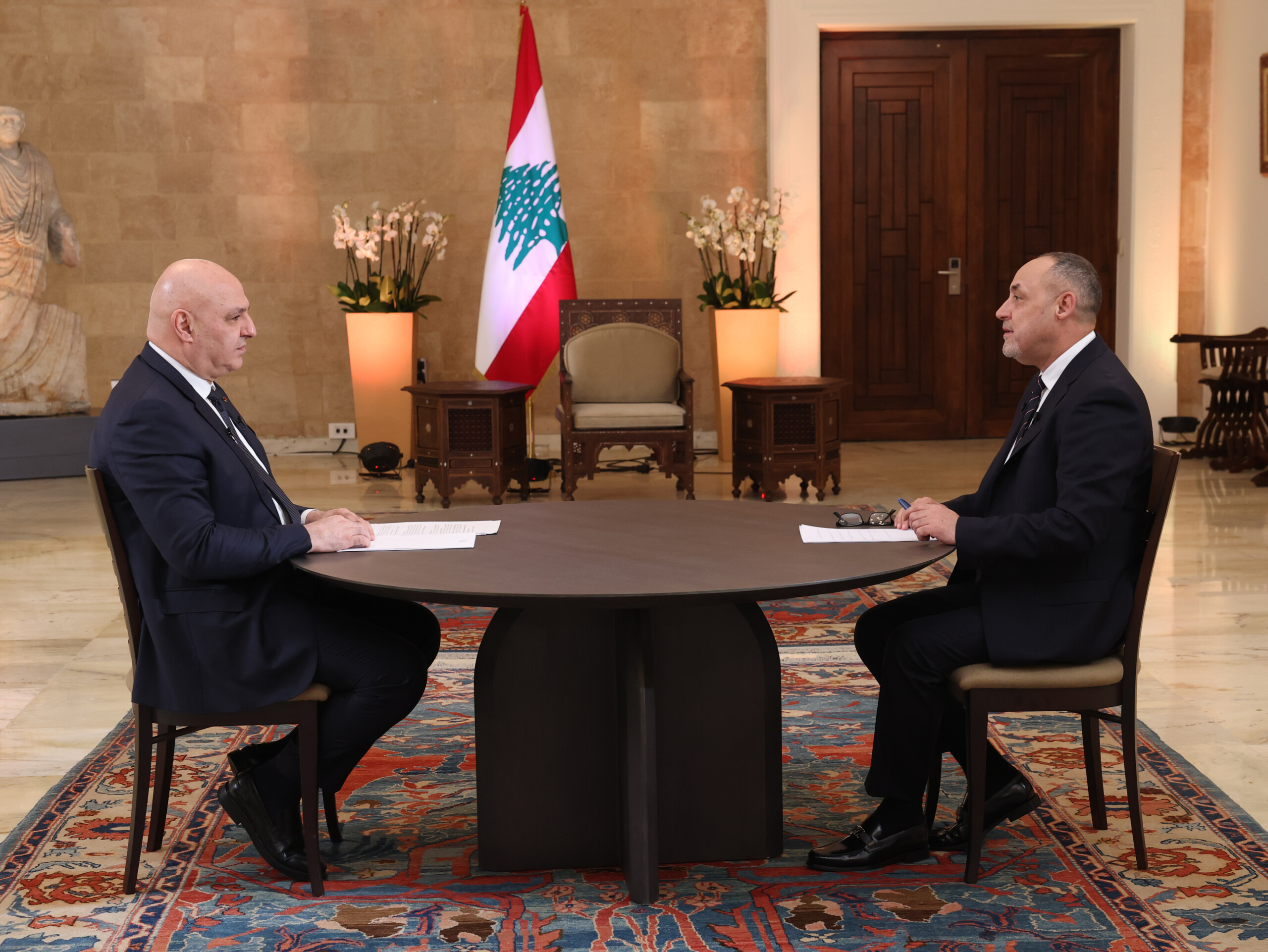
President Aoun’s positions came in an interview with the Iraqi Dijlah TV channel conducted by channel director Nabil Jassim, in which he affirmed that “the inauguration speech I delivered was the result of accumulated experience since I was Army Commander for eight years in service of the military institution, and this made me in contact with various segments of society and politicians, so I formed an idea of what should be done if I reached the presidency, and I put a work plan. I am trying to achieve what was included in the inauguration speech before the end of the presidential term. But let’s be logical and realistic: I may not achieve 100% of this speech, but I will try to achieve most of it.”
He added: If we review what has been achieved during the past two years, we notice that the Lebanese people have the right to demand more than what has been achieved. But if we take into account the conditions and circumstances inside Lebanon, in addition to accumulations of about forty years, and the regional situation, we understand that some delay has occurred. But we formed a government in the fastest time, and began working according to its agenda contained in the confidence statement, from carrying out the required reforms to working to solve the problem of depositors in banks, and restricting weapons and the decision of war and peace to the state. A series of advanced steps were taken, but the war pushed us to focus more on ways to end it. We have recently put reforms back on the right track, so we issued the bank reform law, and soon the financial gap law will be completed, and so on…
President Aoun pointed out that in 2025, economic growth of around 4% was achieved, and for the first time there was a surplus at the Ministry of Finance of around $1.3 billion, and deposits in hard currency at the Central Bank rose by around $2 billion, and we expected in 2026 an increase in growth of around 6%, but the war, which was a major shock, affected the economic situation, and contraction occurred.
Corruption and E-Government
In response to a question, the President explained that “as a result of my experience in leading the Army, it became clear to me that the bulk of Lebanon’s internal problems stem from corruption, caused by mismanagement and lack of accountability. This can be addressed through e-government on the one hand, and the judiciary on the other hand. Today there is a study by the competent authorities to propose a new law for judicial independence. As of September 16, new judicial formations were issued, and judges known for integrity were appointed, and dismantling files and deciding on many abandoned ones began. The Ministry of Justice has achieved many accomplishments thanks to these formations.”
President Aoun affirmed that many files related to combating corruption, which were previously considered forbidden to touch, and enjoy the protection of some politicians, have been opened. There are no longer red lines for anyone, and any file affecting anyone, its owner is summoned to the judiciary and investigated.
Support of Arab Brothers
In response to a question, the President pointed out that Lebanon wishes its Arab brothers would stand by it more, and trust it more. He said: “We cannot deny that some Arab countries stood by Lebanon, but not in the way we wished, due to the previous periods that led to shaking confidence between Lebanon and the Arab group, as well as with the international group. One of the most important things we are working on is rebuilding trust between the Lebanese people and their state on the one hand, and between the state and the Arab and international community. We have to make a greater effort, and in return we hope that our Arab brothers will stand by us more.”
The President pointed out that “restoring confidence requires carrying out reforms. I said and repeat that these reforms we are not carrying out to please external parties, but because Lebanon needs them. It is an internal need before it is an Arab or international need.”
He continued: “I have repeatedly stressed that we do not seek grants and donations, but what is required is investment in Lebanon. From here begins rebuilding trust with Arab and international parties.”
President Aoun said, in response to a question: “I pledged in the inauguration speech to preserve depositors’ funds. According to the law expected to be issued by Parliament, the financial gap will be addressed, and these funds will be returned to their owners. These funds are a right for the Lebanese, they are the fruit of their labor, in addition to citizens of some countries who deposited their funds in Lebanon, and this is their right. This matter requires treatment, and we are determined and resolved to address it, and this requires issuing a law from Parliament, in addition to assistance from the World Bank.”
He added: “According to our statistics, about 84% of Lebanese depositors have less than $100,000, and some of their accounts have been closed successively, according to circulars issued by Banque du Liban, and others must obtain their rights.”
Israeli Withdrawal and Reconstruction
In response to a question, the President affirmed that “what is required first as a basic step is the Israeli withdrawal from southern Lebanon. Studies are available for the reconstruction of damaged areas, and there is a conference for reconstruction and another to support the Army. A step has been taken in this framework in France through holding a preparatory conference for the Army support conference. We are now preparing for a reconstruction conference that may be held even before the Israeli withdrawal. But this withdrawal is the basic step, as conducting a census of destroyed homes in the south cannot be done before achieving this withdrawal. All this, despite the fact that aerial images show that the affected villages have unfortunately become wiped out.”
President Aoun stressed that “Israeli withdrawal is our primary goal, in addition to reconstruction, the return of the displaced, and the release of prisoners. And I recall that Article 10 of the Framework Agreement stipulates support for the Lebanese state in the reconstruction process.”
In response to another question, the President answered: “Regarding the Dahr al-Baidar truck, I do not want to involve politics in the work of the judiciary. The state has taken a decision on exclusivity of weapons, which is one of the basic pillars of any state, in addition to the decision of war and peace. The government has taken a series of decisions in 2025 and 2026 in this direction. The Army and security forces are doing their duty in this framework. Any shipment of weapons or explosives belonging to Hezbollah or others, the Army or security agencies confiscate it. Yesterday, an operation was carried out to confiscate weapons and drugs in warehouses in the Bekaa, and about two days before, weapons were confiscated in Beirut. Likewise, the judiciary is doing its duty. I do not involve politics in the judiciary, but I stress that we cannot continue in a country with two weapons and two decisions. Exclusivity of weapons is necessary, and essential for building the state. This is something I talked about in the inauguration speech, and the government committed to it in the ministerial statement. And all decisions taken by the government were in application and implementation of this principle.”
He added: “Unfortunately, this weapon is no longer used to protect Lebanon, and it is no longer used except to protect regional projects. From 1982 to 2000, this weapon achieved the required result, and Hezbollah martyrs achieved accomplishments, most notably the liberation of the south, and they are thanked for their sacrifices. But after 2000, their weapon turned to another agenda. And this led to the 2006 war, and the 2023 and 2026 wars. These were wars that were not necessary for Lebanon, and it had no relation to them. We would have saved our people in the south a lot of destruction and killing. In 2026 alone, we have more than 4,400 martyrs, apart from total destruction that affected entire villages.”
President Aoun explained: “From a military point of view, how did we help Gaza with the support war? We could neither help it, nor stop the war on it, but rather destroyed ourselves, and brought the war onto our land. And in 2026, how did we help Iran militarily, and how did we benefit it? And what was the result? After the 2023 war, we had about 5 hills occupied by Israelis, and a small number of destroyed border villages. And today we have a large part of the south occupied, and all villages under occupation completely destroyed, and we could not achieve a military result by supporting Iran. So I ask: ‘Why were these two battles? They were not to serve Lebanon, but rather formed a burden on it.'”
Exclusivity of Weapons
The President said in response to a question: “The state has taken decisions on exclusivity of weapons, and the Army is deployed and is doing its duty over the entire Lebanese territory with all security agencies. The decision has been taken, and we are determined on it, even if it takes some time. And we will proceed with it to the end. At the same time, we are trying, through direct and indirect contacts, with Hezbollah, to confirm that this weapon is no longer useful, and the state is the one that protects everyone and is caring for its sons. And we say to the party: You are Lebanese, and you are part of the state. Please hand over your weapons so that we can have a strong central state that takes care of protecting its sons, at home and abroad.”
President Aoun affirmed, “We never think of reaching internal clash among our options. Rather, we are making contacts, whether with the Israeli side through the American party to oblige it to implement the framework agreement which includes reciprocal steps, or with Hezbollah. We are talking with the party and calling on it to talk together in order to reach a peaceful solution for its weapons. And I repeat the question: What did military action achieve? It only brought destruction to Lebanon. We are not different on the goals. Both of us want one goal: Israeli withdrawal, return of the displaced, reconstruction of the south, and release of prisoners. But we differ on the method. And I ask the party: Are you able to achieve these goals by war? If you are able to achieve it by war, I am with you. But if you are not able to, then there is a second language, diplomacy and negotiations, and there are many examples in the world. This language, even if it does not give immediate results, remains less costly than any military action. And military action will not lead to any result. And it will only lead to more ruin and destruction. We must mitigate negative results. If you are truly keen on the Shiite environment and on the Lebanese state, and I have no doubt about this keenness, you are supposed to put your hand in the hand of the Lebanese state, and work to agree on a mechanism for handing over weapons. And in return, the state undertakes to negotiate through the American party or friendly countries to oblige Israel to implement the framework agreement.”
In response to a question about the Lebanese state’s position on the possibility of Hezbollah opening a front on the borders, President Aoun directed a message to Hezbollah that any rocket launched from the south will be met with more destruction and displacement and martyrdom of Lebanese families, and any military action will have major repercussions, and the Shiite environment can no longer bear it. Southerners in general, and members of the Shiite sect in particular, have been paying since 1969 the price of others’ wars on its land.
He believed that the party has the necessary concern and fear for its environment, so it must deal rationally and realistically, and not drag the country into a third support war because its outcome will be dire for it and for Lebanon and the Shiite environment in particular. In this framework, it is important to return to what the Shiite reference Sayyed Ali al-Sistani said in Asharq Al-Awsat newspaper on October 14, 2025, which is a message from him to Hezbollah leadership, which arrived after the pager explosions in Lebanon, weeks before the assassination of the party’s former Secretary-General Sayyed Hassan Nasrallah, in which there is a warning of a war without rules in the region, and emphasis on protecting the lives of all civilians in Lebanon.
He says: “Encouraged to take decisions that give top priority, not only to protecting Shiite believers, but to all civilian residents of Lebanon, and that Lebanon should not be dragged into wars that serve external agendas that increase the suffering of its people.”
And on November 4, 2024, the reference al-Sistani addressed Iraqis, and I hope it is not understood from my words that it is interference in internal affairs, because it is a message that applies to the Lebanese reality. The reference al-Sistani affirmed that Iraqis, especially aware elites, should take lessons from the experiences they went through, and exert their utmost effort to overcome its failures, and work hard for a better future for their country, in which everyone enjoys security, stability, advancement, and prosperity, affirming that this cannot be achieved without preparing scientific and practical plans to manage the country based on the principle of competence and integrity in assuming responsibility positions and preventing external interventions in all their forms and ruling the rule of law and restricting weapons to the state and combating corruption at all levels.
He also renewed on June 27, 2025, the call to restrict weapons to the state, in the first position after the announcement of ceasefire between Iran and Israel. His representative in Karbala, Abdul Mahdi al-Karbalai, said: The path must be corrected and what has passed must be remedied, and external interventions in all their forms must be prevented, and weapons must be restricted to the state and corruption combated. The message indicated that it is not permissible to leave the Lebanese Shiite community exposed to a new war.
President Aoun expressed his belief that the message is clear.
Negotiations with Israel
In response to a question about the continuation of Israeli violations currently, and whether negotiations are still ongoing and the possibility of new rounds to push this file forward, President Aoun renewed the affirmation that the only available option is negotiations and diplomacy, and this means the possibility of complicating matters in one place and facilitating them in another, and the last round was technical and the Lebanese Army delegation presented a wonderful technical presentation on the approach to reality on the ground, while the Israeli delegation’s answer was the necessity of returning to the political authority there. Despite our awareness that the meeting was held on the eve of the Israeli elections, but the American party, like us, wanted to maintain momentum to the next stage, and we expect second, third, and fourth rounds, but that is pending the formation of the Israeli government, but in absolute terms, I stress that we have no option but to adopt diplomacy, for negotiations are not a concession, and the negotiator must know how to do his job and assess when to be firm and when to be flexible. And there is an example of what the late President Anwar Sadat did when he waged the 1973 war to liberate Sinai, thousands of martyrs from the Egyptian army fell without being able to liberate, so he found no option but negotiations which lasted about four years, until withdrawal was achieved and he paid his life as a price for that, but he achieved in negotiations a goal without human losses. Therefore, the option of negotiation remains the best, true that success is not guaranteed 100%, but any percentage that achieves success must be supported, for the alternative is war and we know what its result is.
In response to a question about Israel verifying the issue of disarmament in Lebanon, which he opposes, President Aoun stressed the unacceptability of anyone undermining Lebanese sovereignty and the role of the Lebanese Army, and whoever wishes to verify can resort to an international team (Arab or European), but it cannot be Israeli because it is unacceptable for it to be both adversary and judge at the same time, and this is illogical, for the adversary cannot be the judge and this is what cannot be accepted in any form.
As for the existence of American guarantees on a timetable for Israeli withdrawal, President Aoun explained that the United States signing the framework agreement is in itself a guarantee, for there is no timetable and that is what must happen of course, and there are no things guaranteed 100%, but when any party, whether a state or an official, signs an agreement, it is required to respect it.
Lebanon and the Danger of US-Iran War
On the possibility of a war breaking out between America and Iran, and the Lebanese state’s plan to avoid any crisis in this case, President Aoun affirmed that he relies on the awareness existing in Hezbollah and its keenness on its environment and not entering into war, because it will be devastating, and every rocket launched from Lebanon will not be able to achieve the desired result, while it will be a cause for more displacement, harm, destruction, and killing.
In response to a question about Lebanon saying it is not a bargaining chip in Iran’s negotiation with America, and about the new relationship between Beirut and Tehran, President Aoun explained that the discourse is not sharp, and Lebanon is a sovereign state that has suffered a lot of interventions in its affairs throughout history. He added: I was clear in my meeting with the Iranian President and Foreign Minister at several stages, regarding the pursuit of the best relations with Iran but built on mutual respect and non-interference in internal affairs. What the Iranian does not accept for himself, I cannot accept for Lebanon, for dealing is welcome from state to state, but not from a state with a Lebanese group without passing through the Lebanese state, for this is unacceptable. And when the memorandum of understanding between America and Iran was made, no one consulted us or took our opinion, and this is unacceptable, because we must be at the negotiating table, not on it.
In response to another question about the relationship between Lebanon and Iran, President Aoun stressed the importance that the relationship with Iran be based on mutual respect, and from state to state. He said: The Iraqi state helped Lebanon in many stages, but through the Lebanese state, and any assistance from any state is welcome, as is any desire to develop relations with any state, but through the Lebanese state and not with a group of Lebanese, for establishing a relationship with a group of them cannot be translated, and it is not constitutional or legal, and it cannot be dealt with a group of people and not with the state. We desire the best relations with Iran and all countries of the region, but based on the principle of non-interference in internal affairs, we do not accept interference in the affairs of others and we also do not accept interference in our internal affairs, for Lebanon has suffered what it has suffered from these interventions.
Relationship with Syria
On his assessment of the course of relations with Damascus, President Aoun said: The relationship is good and developing, and exchange of delegations is in this framework. I have met President al-Sharaa more than once, and the talk was clear regarding non-interference by either country in the internal affairs of the other, and I was clear in not desiring a return to what things were with the former Syrian regime, and the necessity of looking to the best relations, and that by virtue of neighborhood, security and military cooperation must be established, and the relationship must be equal as the Lebanese proverb says “if your neighbor is well, you are well.” We do not accept Lebanon being used to threaten Syria, and vice versa, and we seek the best relations and things are moving in the right direction for the good and interest of both countries.
In response to a question about the thorny history and pending files between Lebanon and Syria, President Aoun explained that cooperation is ongoing between the two countries and there are mutual ministerial delegations, and the current dealing is based on respect and through the state and not through another party.
Lebanon and Iraq
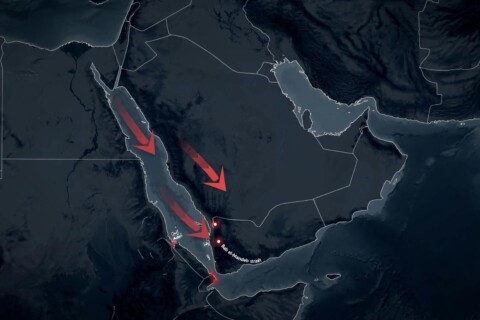
President Aoun concluded the interview by answering a question about the expected visit of the Iraqi Prime Minister to Beirut, and the realism of proposing the Iraqi oil path to Tripoli, saying: In my first visit to Iraq, I met Prime Minister al-Sudani and there was talk about this matter, and when Prime Minister Ali al-Zaidi was assigned to form the Iraqi government, I spoke with him during my congratulations to him, on this subject and we welcome him in his home, and relations with Iraq are deeply rooted in history, and during the 1950s, there was an oil pipeline flowing to the north and its source was Iraq, and it still exists, and there was talk about activating this pipeline to be an alternative to the Strait of Hormuz until conditions improve, and there is nothing preventing it, and I expressed full willingness to put Lebanese ports at the disposal of Iraqis and to receive Iraqi tankers as well pending repair of the line, or to use Lebanese tanks and the possibility of exporting crude oil from Lebanon, and it is realistic and not difficult, and will be among the points of discussion.
In response to a question about the possibility of Iraq demanding the recovery of Iraqi political money, much of which arrived in Beirut, President Aoun affirmed full Lebanese cooperation in this field, and President Aoun said that no state can be built if corruption is still rampant in it.
President Aoun concluded by addressing Iraqis, calling on them to come to Lebanon “their second country,” and that they are welcome, and that the relations existing between the two countries are old and no one can affect them negatively.