
President of the Republic receives Arab agriculture ministers and FAO representatives:
The agricultural sector is the backbone of the economy, and its recovery is not only an economic issue but a key element for the people of the South to hold on to their land
President Aoun: I was among the first to launch the initiative for economic integration between Arab countries, to activate our economies and form a strategic component for our countries, which have huge agricultural capabilities
Minister Hani: Our meeting aims to set a working mechanism for the quadripartite agreement signed in 2023, to develop agricultural research, exchange expertise and encourage joint investments
Iraqi Minister of Agriculture: Agriculture brought our countries together, while other sectors could not do that, and integration between brothers is a must
Syrian Minister of Agriculture: We benefit from the experience of our brothers in Lebanon, especially in marketing products, and we look forward to major integration between us
FAO Assistant Director General and Regional Representative for the Near East: There is a very big opportunity to create a successful model for the flow of goods and their seasons, between production time and export time
Director General of the Arab Organization for Agricultural Development: We confirm the readiness of the Arab League to exert every possible effort to facilitate this integration, so it can become a model for other countries
President of the Republic, General Joseph Aoun, affirmed that the agricultural sector is the backbone of the economy. He noted that losses in this sector reached about 620 million dollars as a result of the war Lebanon was subjected to, especially in the border areas, and he stressed the importance of the recovery of this sector, not only as an economic issue, but as a key element for the people of the South to hold on to their land and stay in it.
President Aoun renewed his call, which he was among the first to launch since his election, for economic integration between Arab countries, similar to the European Union.
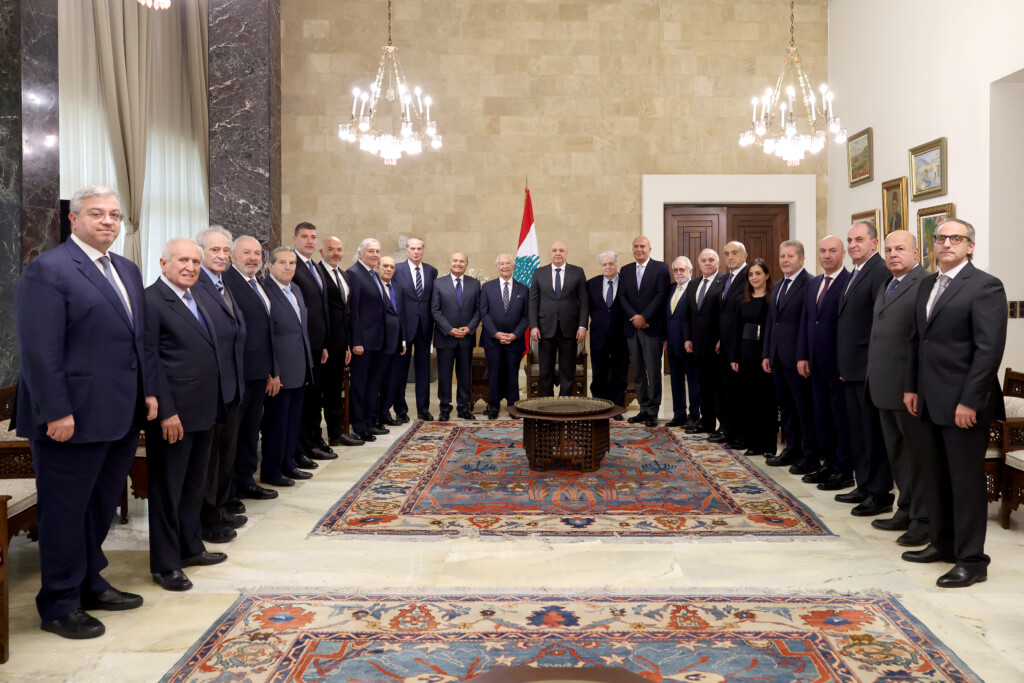
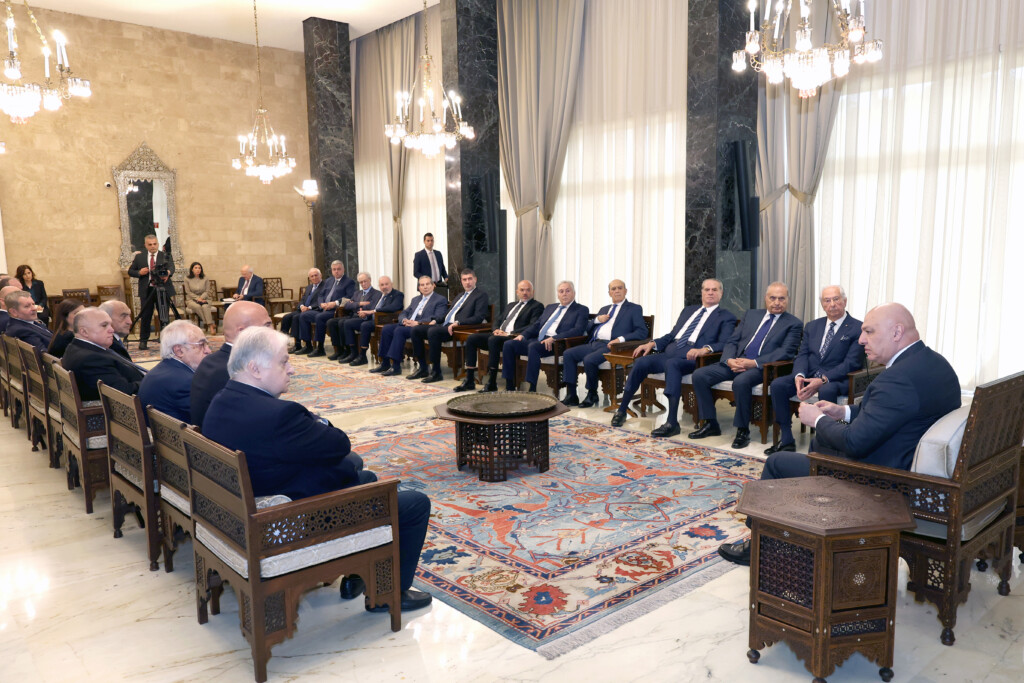
The President’s remarks came during his reception at Baabda Palace, before noon today, of a delegation of Arab agriculture ministers and representatives of the United Nations Food and Agriculture Organization, FAO, in the presence of Minister of Agriculture Dr. Nizar Hani.
At the start of the meeting, Minister Hani spoke, thanking President Aoun for receiving the delegation, “and for his continuous support for the agricultural sector since the first day of his term,” recalling the slogan previously launched for the Ministry of Agriculture: “Agriculture is the pulse of the land,” to which, he said, “Your Excellency added: … and life.”
After introducing the members of the delegation to President Aoun, he said: “The goal of our meeting today is the quadripartite agreement that includes Lebanon, Syria, Jordan and Iraq, signed in 2023 in Syria, but it remained ink on paper. We will hold two sessions before noon today to set a working mechanism for it, to show how to activate and develop it, in addition to how to develop agricultural research and exchange expertise, and encourage joint agricultural investments, and most importantly how agricultural products flow between these countries, and facilitate procedures at all levels.”
He continued: “FAO plays an important role in Lebanon, especially in the agricultural sector. We are trying to create a model based on a grouping of neighboring countries cooperating to achieve agricultural integration. The specialized Arab organizations are keeping up with our work, each in its field and specialty, with the aim of achieving a model agricultural relationship that can be transferred to North African countries and other countries.”
President Aoun’s reply
The President of the Republic welcomed the delegation, and praised the role its members are playing to raise agricultural cooperation in the countries of the region to serve the interests of their people. He said: “I am a son of the land, and I am proud that my parents worked in agriculture, which is the backbone of the economy. I am pleased that this meeting brings us together to discuss practical steps that serve our farmers and strengthen our food security.”
He praised what the Minister of Agriculture did in terms of “setting a ten-year national strategy for the agricultural sector for 10 years, 2026-2035, which clearly defines how to develop this sector and direct investments in it.” He pointed to the losses in the sector, estimated at about 620 million dollars as a result of the war Lebanon was subjected to, especially in the border areas. He stressed the importance of the recovery of this sector “not only as an economic issue, but as a key element for the people of the South to hold on to their land and stay in it.”
President Aoun said: “I was among the first, since my election as President of the Republic, to call for economic integration between Arab countries, similar to the European Union, starting with facilitating the exchange of goods and services, let alone between the countries of the Arab Mashreq, where we can form a kind of economic bloc. We hope your meeting will be a good omen for that, starting from agriculture. We also look forward to activating the work of the joint technical committee, for the benefit of the four member countries, and consequently all Arab countries.”
He addressed the FAO representatives, saying: “We look forward to your technical support, especially in preparing an implementation plan with a clear timetable, which contributes to the experiment of exchanging phytosanitary certificates electronically, which would facilitate completing transit procedures and reducing delays related to paper transactions.”
President Aoun renewed his wishes for success to the members of the delegation in their missions, thanked them for coming to Lebanon, considering it “a sign of confidence in our country,” and affirmed “that agricultural integration between the four countries is essential to activate our economies, and a strategic component for our countries, which enjoy huge agricultural capabilities.”
Dialogue
After that, a dialogue took place between the members of the delegation and the President of the Republic. Jordanian Minister of Agriculture Dr. Saeb Khreisat spoke, praising President Aoun’s call for economic integration between the countries of the region as a prelude to broader integration. He pointed out that the open spirit present, starting from Lebanon, strengthens food security, considering that the brotherly relationship linking the Hashemite Kingdom of Jordan with Lebanon is moving towards further progress.
Iraqi Minister of Agriculture Mr. Abdul Rahim Al-Shammari spoke, conveying the greetings of the Iraqi government and people to President Aoun and the Lebanese people, and said: “Agriculture brought our countries together, while other sectors could not do that, and this is joyful. We would like each of us to have self-sufficiency in agricultural matters, and if that is not achieved, then integration between brothers is a must.”
After that, Syrian Minister of Agriculture Engineer Bassel Al-Suwaidan spoke, stressing that communication is ongoing between Syria and Lebanon, especially to solve problems that may arise regarding the agricultural sector. He affirmed that “in the coming days there will be great work between us, so that we benefit from the experience of our brothers in Lebanon, especially in marketing agricultural products, given that we have vast agricultural areas. From here we look forward to great integration between us.”
Assistant Director General and Regional Representative of FAO for the Near East, Dr. Abdul Karim Al-Waer, spoke, stressing that “Your Excellency’s initiative for agricultural integration is unique at the FAO level globally. We wish for its success with the aim of adopting it as a pioneering experience to be generalized to the rest of the world.” He added: “There is a very big opportunity, especially in delving into technical aspects, which enables finding a successful model for the flow of goods and their seasons, between production time and export time.”
In conclusion, Director General of the Arab Organization for Agricultural Development, Professor Ibrahim Al-Dukheiri, spoke, stressing the importance of integration between agricultural currents and agricultural investment to overcome all obstacles, confirming “the readiness of the Arab League to exert every possible effort to facilitate this integration, so that it moves to become a model for other countries.”
Minister Hani’s statement
After the meeting, Minister Hani spoke to journalists and said: “Our meeting today, alongside colleagues: Their Excellencies the Ministers of Agriculture in Iraq, Jordan and Syria, and the Regional Representative of FAO, with His Excellency the President of the Republic, is to launch a day of discussions to develop and activate the joint quadripartite agricultural agreement between: Lebanon, Syria, Jordan and Iraq. This agreement was signed in 2023, and today we are about to hold the first official meeting that includes all those concerned with it, in order to develop it and activate it and set a clear work plan to advance agricultural relations between the four countries, in terms of scientific research, developing cooperation, exchanging expertise, agricultural integration, encouraging joint agricultural investments, and most importantly facilitating the movement of agricultural crops between the concerned countries, and facilitating procedures at all levels so that agricultural crops of good specifications reach the countries they move to.”
He added: “We are taking advantage of the presence of Their Excellencies the Ministers, to open the Agri Lebanon exhibition. From here, I invite the whole agricultural family to go to this exhibition, to be a space for exchanging information and increasing capabilities in the agricultural field.”
In response to a question, he said: “The main goal of our meeting today is to discuss how to facilitate trade exchange and accelerate the flow of goods between borders, and facilitate procedures related to laboratories, tests and monitoring at borders. The reason for the presence of the FAO representative with us is that it has experience in regional cooperation. We hope that this cooperation resulting from the agreement will be a very good model that applies to all economic sectors between the countries of the Arab Mashreq.”
Baabda, 19/11/2026
Political, religious and economic meetings at Baabda Palace
President Aoun received the head of the Alawite Islamic Council
Sheikh Qaddour: We support the positions of the President of the Republic and his national choices, and we are confident that the future will bring us more cohesion and national unity
President Aoun received a written message from President Putin, conveyed to him by the Russian Ambassador, in which he affirmed his country’s support for the sovereignty of the Lebanese state, the integrity of its territory and its national unity
President of the Republic receiving a delegation of the Union of Lebanese International Business Councils:
The private sector is the backbone of the economy
President Aoun: Reforms have been at the heart of our priorities since the start of the term, and restoring confidence takes time, but we are determined to build a state of law, institutions and transparency
Baabda Palace witnessed, before noon today, political, religious and economic meetings, where the President of the Republic, General Joseph Aoun, received the head of the Alawite Islamic Council, Sheikh Ali Mahmoud Qaddour, and discussed with him the general situation in the country, in addition to the situation of the Alawite community in Lebanon. Sheikh Qaddour affirmed during the meeting full support for President Aoun’s positions and his national choices, and for the steps he is taking in cooperation with the government, foremost among them extending the authority of the state over all its territory.
Statement by Sheikh Ali Qaddour
After the meeting, Sheikh Qaddour told journalists: “I am pleased to have the honor of meeting the President of the Republic at Baabda Palace, where we discussed the general situation in the country, and the situation of the Alawite community in Lebanon. I confirmed to His Excellency, on my behalf and on behalf of the sons of the Alawite community, our full support for his positions and his national choices, and for the steps he is taking in cooperation with the government, foremost among them extending the authority of the state and strengthening its institutions, preserving civil peace and national unity, and protecting Lebanon at this delicate stage. We are confident that his term is a real opportunity to build a state of law and institutions.”
He added: “The meeting also dealt with the demands of the Alawite community and its rights, especially the presence of its sons in public jobs and in official administrations and institutions, civil and military, in accordance with the principle of fair participation and equal opportunities, and competence and equality among all Lebanese. We sensed from His Excellency understanding and keenness to do justice to all Lebanese components, and we look forward to translating that practically in a way that strengthens the belonging of the sons of the community to their state.”
“The sons of the Alawite community, rooted in Lebanon, will remain alongside the state and its legitimate institutions, foremost among them the Lebanese Army, adhering to coexistence and national unity. May God protect Lebanon and its people, and grant His Excellency the President success in what is best for the homeland.”
Asked: Did the President of the Republic give you reassurances and guarantees about the next stage?
He answered: Seeing His Excellency’s face alone brings optimism to our souls, and we heard from him reassuring words, as he spoke of a bright and promising future for Lebanon in all social, economic and political aspects.
In response to a question about his fear of internal divisions, he answered: On the contrary, we are confident that the future will bring us more cohesion and national unity.
Message from President Putin
On another note, President Aoun received a written message from Russian President Vladimir Putin, conveyed to him by the Russian Ambassador in Lebanon, Alexander Rudakov, in which he affirmed his country’s position supporting the sovereignty of the Lebanese state, the integrity of its territory and its national unity.
While President Putin congratulated the President of the Republic on the 83rd anniversary of Independence, he said he is “confident that the traditional friendly relations linking Russia and Lebanon will continue to move forward, for the good of our two peoples and the interest of consolidating security and stability in the Middle East region.”
During the meeting between President Aoun and Ambassador Rudakov, bilateral relations between the two countries and ways to strengthen them in all fields were discussed.
Union of Lebanese International Business Councils
In addition, the President of the Republic received the head of the Union of Lebanese International Business Councils, Mr. Raphael Dabbaneh, with a delegation from the councils. At the start of the meeting, Mr. Dabbaneh spoke about the Union, which “currently has 29 business councils, and the heads of these councils who have the honor of being present today here as guests of Your Excellency have large and effective relations with the countries with which they aim to open up and activate these relations, which constitutes one of the main pillars relied upon to achieve the desired goals from the existence of these councils, including determining a comprehensive working mechanism that allows them to consult and coordinate among themselves to develop a common vision and work plans and programs to enhance economic cooperation, contributing to activating their role and strengthening Lebanon’s economic relations abroad and encouraging the establishment of work partnerships in various countries of the world. In addition to strengthening trade partnership between Lebanon and the concerned countries and working to establish harmonious relations in the economic field and proposing recommendations aimed at improving economic partnership with these countries.”
He added: “The councils also seek to remove obstacles that may arise in the way of successful exchange of goods and services with these countries, with proposals to develop the agreements and protocols in force. They also seek to establish a network of relations between businessmen and women belonging to these councils to benefit from opportunities available in different countries. We also pay special attention to coordination with the Ministry of Foreign Affairs and the Ministry of Economy and economic attaches in foreign embassies in Lebanon. The councils work to seek to facilitate obtaining entry visas for businessmen to the concerned countries. A platform is currently being created that brings together council members and displays opportunities and projects available for investment between Lebanon and the countries for which business councils have been established.”
He continued: “With the aim of expanding the scope of activities, the Union of Councils is working to succeed in establishing parallel business councils in the concerned countries to facilitate providing economic information on potential investment opportunities between Lebanon and these countries. Finally, the Union of Councils seeks to launch new business councils with several countries of interest to businessmen in Lebanon.”
He concluded: “On my behalf and on behalf of all the heads of the international Lebanese councils present here today, I extend to Your Excellency our sincerest and warmest thanks for your generous hospitality, and we wish Your Excellency continued health and success in bringing our dear Lebanon to the shore of peace, for the good of all Lebanese. We take advantage of the Independence Day occasion to congratulate Your Excellency on this national holiday, and we are certain that under Your Excellency, our Lebanon will reach the shore of safety and prosperity to which we all aspire.”
President Aoun
President Aoun welcomed the delegation, stressing the importance of the private sector, “which is the backbone of the economy.” He said: “The sons of this sector are economic ambassadors for Lebanon abroad, and a bridge between Lebanon and friendly countries, and I count on you to restore confidence in our national economy, and let us move from wishes to tangible projects.”
He added: “The real partnership between the private and public sectors is essential, as it turns mutual relations into investments, projects and job opportunities. It is certain that security and political stability bring economic stability. Any investor needs stability, and this is what we seek. We are working to consolidate stability and protect Lebanon’s sovereignty. The war left great damage on the economy and productive sectors, but we look forward to an essential role for the private sector in recovery, especially in reconstruction.”
The President of the Republic pointed out that “the internal security situation in Lebanon is stable, even if some try to distort the image of the real reality. It is stable and the crime rate in Lebanon is much lower than in a number of countries,” adding: “I invite you to be encouraged and encourage others from inside and outside, especially Lebanese abroad, to move forward to develop your sector.”
He said: “What I see of boldness in you and creative and innovative initiatives reassures me that Lebanon’s economy will launch with new momentum. The proof of that is that we achieved in 2025 growth of about 4%, and the Ministry of Finance achieved a surplus, while the value of the Central Bank’s foreign currency assets increased. But unfortunately the war set us back. And what happened in the last war between the United States and Iran also affected the economies of the world as a whole.”
He addressed the members of the delegation, saying: “No fear for Lebanon with additional stability and the presence of a private sector like the one you represent,” stressing cooperation between the state and the private sector, starting from working to attract investors to holding conferences in this regard and other activities that put things back on the right track.
He pointed out that “the Lebanese possess an inexhaustible wealth represented by human capital, with its material and intellectual energies, and the number of Lebanese spread abroad, which is a capital that several countries lack.” He said: “I am not exaggerating in saying that we do not need anyone from abroad to help us to rise again. Lebanon has passed several bumps but it rose again, and it is the duty of the state to carry out financial, administrative and economic reforms, in addition to supporting e-government. We have many promising opportunities in energy, infrastructure, communications, technology, tourism, industry and agriculture.”
He continued: “Reforms have been at the heart of our priorities since the start of the term. Restoring confidence takes time, but we are determined to build a state of law, institutions and transparency.”
President Aoun concluded by pointing to “several projects, from launching work at Qlayaat Airport, through the highway project in three stages between Tripoli and Qlayaat and the railway project, to expanding the Port of Beirut, and launching the study of the tunnel between Beirut and the Bekaa. All of this comes as a complement to our joining the club of ports of the economic corridor between India, the Middle East and Europe. It is regrettable that some ask, with these achievements, what have you done? Do we forget that the country was left for forty years to mismanagement, corruption, absence of judiciary and lack of development in the administration.”
The delegation, in addition to Mr. Dabbaneh, included heads and representatives of business councils between Lebanon and each of the following countries: Greece, Syria, Iraq, Russia, Turkey, Italy, Cyprus, Oman, Brazil, Spain, Bulgaria, Saudi Arabia, Belarus, Ukraine, Belgium, Egypt, Germany, Korea, Qatar, Kuwait, Antigua and Barbuda, the Emirates, and Switzerland.
Director General of Oil
On another note, the President of the Republic discussed with the Director General of Oil, Maurice Al-Qarqafi, the oil reality in the country and the situation of oil facilities and the procedures adopted to continue securing Lebanon’s needs.